Usability Test
The evaluation primarily focused on collecting qualitative data regarding the usability of the design, including assessing the limitations of the technology within the context of use and identifying any confusion in the user journey. Additionally, it aimed to uncover users' emotions and satisfaction with the experience. To achieve this, a "think aloud" approach was adopted during the user evaluation to reveal participants' internal cognitive processes.
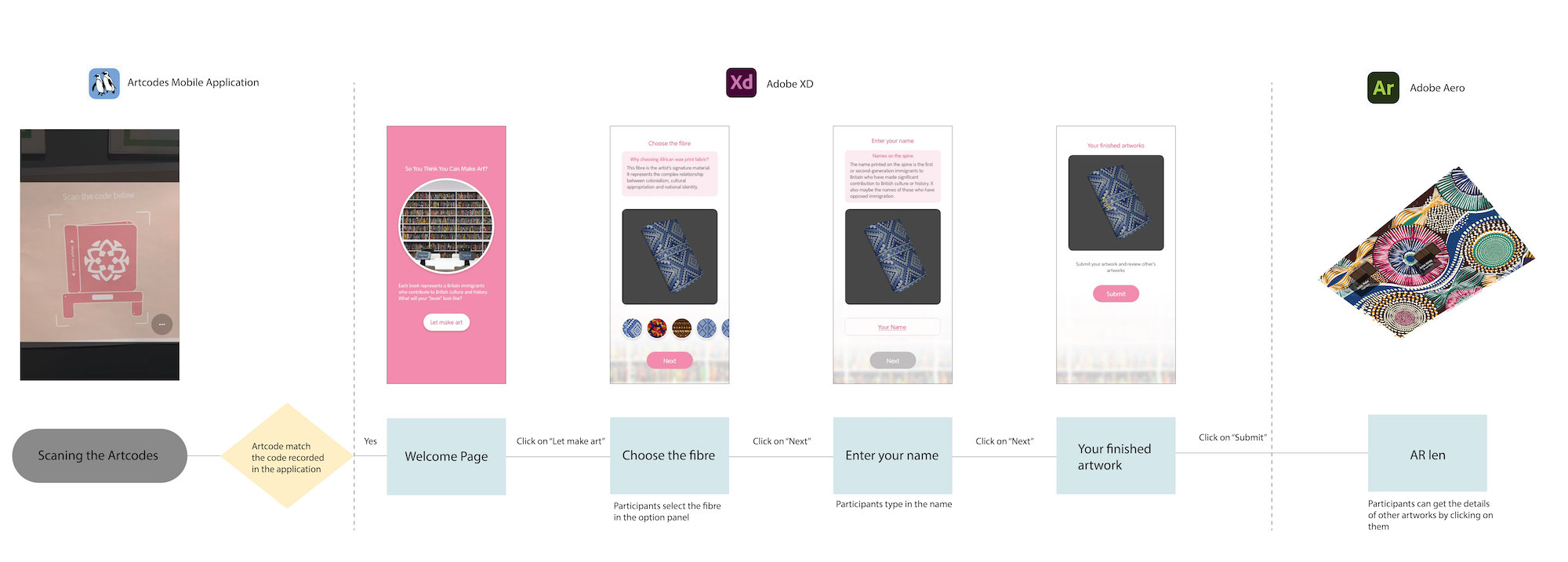
To simulate the museum environment, the university's library was chosen due to its various similarities with an art gallery environment. It was discovered that the prototype lacked precise instructions, leading to confusion among participants engaging with the experience. For example, participants struggled with scanning the Artcode and understanding the rationale behind selecting the fiber for the book and typing their name in the game. To address these issues, instructions for the mini-game and Artcode should be more specific, unfolding the sequence of the experience. Additionally, providing explanations about the meaning and creative process of the artwork before the mini-game could help visitors understand the rationale behind the tasks in the game.
Participants also encountered issues with scanning the Artcode due to wrinkles on the poster and reflections on the monitor, which raised concerns about the choice of medium for presenting the marker. To mitigate inaccuracies in scanning the Artcode, it should be presented in a more permanent method, such as laser cutting the Artcode with non-reflective material.
The positions of the marker and virtual objects in the AR experience significantly influenced the accessibility of the experience. To address this issue, two or more sets of markers are placed at different heights to accommodate different participants. Additionally, as users reported fatigue in their necks from looking up, the position of the scenery is adjusted to a comfortable eye level for all participants.